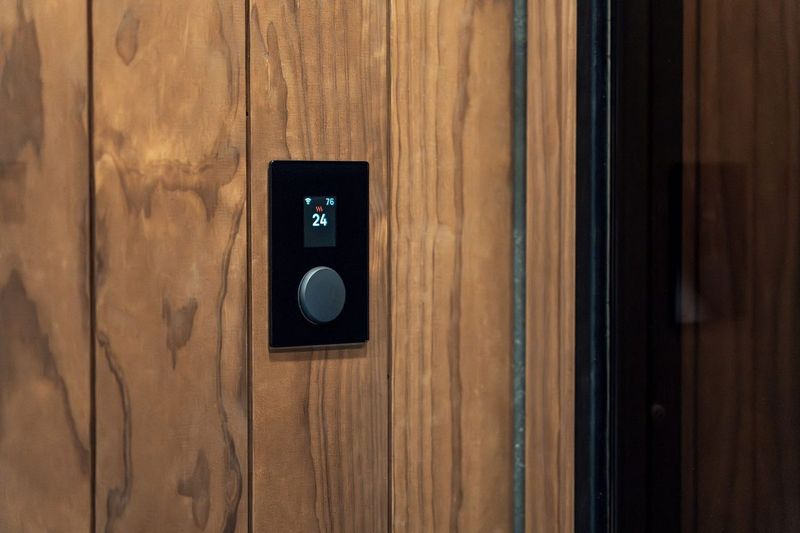
At 2.10am on a Tuesday last week I was standing in the kitchen in my socks, reading the in-home display by its own glow. It said 165 W. Everyone in the house was asleep and nothing was running that I knew about, yet the house was using as much power as one old 100-watt bulb and most of a second, left on all night. I stood there for a few minutes watching the number, and Pickle came in to watch it too.
What the house uses by just existing
The heating has been off since mid-May, which means the smart meter finally shows us what the house costs to run when we aren't heating it. At 165 W that is about 4 kWh a day. At roughly 25p to 27p a kWh, that works out at around a pound a day, or £30 a month, before the standing charge, just for the house to be switched on. I had never thought of it as a bill, because it doesn't arrive as one.
So I bought a £12 plug-in energy monitor and went round the house with it for two weeks. Plug the monitor into the wall, plug the appliance into the monitor, leave it for 24 hours, write down the number, repeat. Matt asked if the house was going to be allowed to keep any secrets. This is what turned up:
- Fridge-freezer: 1.1 kWh a day, about 46 W on average
- Router and fibre box: about 11 W
- TV, soundbar and set-top box on standby: about 14 W
- Matt's desktop: around 9 W asleep, about 130 W when he is using it
- Monitor, dock and chargers in the box room: about 12 W with nothing in use
That accounts for about 92 W of the 165. The rest I can't measure with a plug-in monitor. I suspect it's the interlinked smoke alarms, the boiler's control board and pump on standby, the display itself and an assortment of chargers sitting in sockets with nothing attached. Matt's theory is that the house is simply thinking about things.
The fridge-freezer, and the sums
The fridge-freezer is Dennis's, from 2008, and at 1.1 kWh a day it costs about 29p a day, or £105 a year, to keep cold. I looked at the labels on new ones. A modern fridge-freezer of the same size might use around 0.4 kWh a day, which would save roughly £66 a year at current rates. Spend £450 on a new one and you're looking at nearly seven years to get the money back, and that's before you count the one you've thrown away still working. Our decision was to keep it until it dies, and then replace it with something efficient. It's a decision made with a calculator and not a lot of enthusiasm.
Small changes, and hot water
We've made two changes. The TV, soundbar and box now go off at the wall at night, which takes out 14 W, and the box room chargers are on a switched strip. Together that's about 22 W, which at our rates is roughly £50 a year for about four seconds of effort a day. We don't have a tumble dryer, so there was nothing to unplug there, and the washing has been going on the rotary line, where it dries in about three hours in this weather.
Gas is the other half. With the heating off, the boiler only heats water, and over the four weeks to 24 June we used 148 kWh of gas, about 5.3 kWh a day. At 6p to 7p a kWh that is under 40p a day, plus a standing charge that doesn't care how much we use. Bath nights show up on the display as spikes, which makes me feel faintly watched in my own bathroom. The combi heats water as it goes, so there's no tank to leave hot, and the dial is set to 50°C.
The fridge-freezer, for the record, has started humming a bit louder this week. I think it knows.