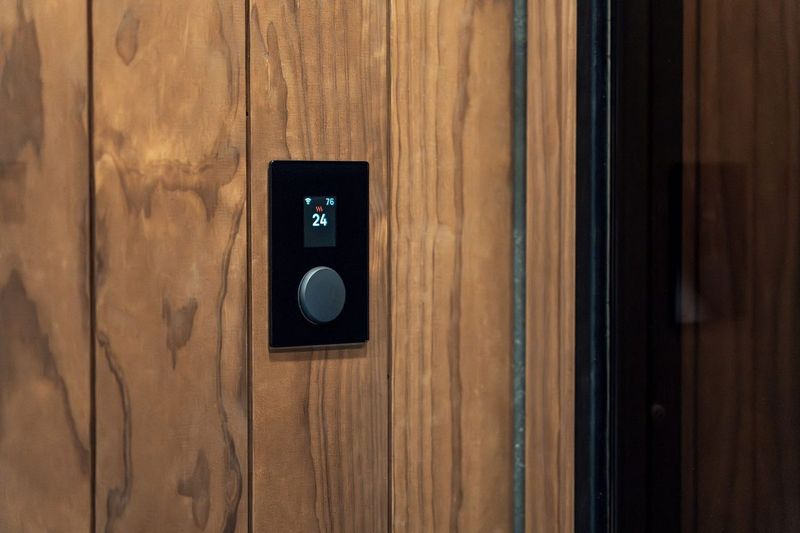
The radiator in the front room was too hot to hold my hand against for more than a second, so I held it there for another second to be sure. That was on Sunday 31 August, one of the first mornings with a proper chill in it, and when I read the little display on the boiler later I found out what I'd been touching: 75°C. That was the temperature our boiler had been sending to all seven radiators since long before we moved in.
Why 75 is a lot
A condensing boiler gets extra heat out of its exhaust gases by cooling them until the water vapour in them turns back into liquid. That only works well if the water coming back from the radiators is cool enough, roughly 55°C or below. If the boiler sends out water at 75°C, the water returning rarely cools that far, so for much of the winter the boiler isn't condensing, and a condensing boiler that doesn't condense is giving away some of its efficiency. That is my reading of the Energy Saving Trust's pages, anyway, and I'm not a heating engineer.
The heating temperature turned out to be a user setting. The manual Dennis left in the kitchen drawer says so, with a dial on the front of the boiler for it. We touched that dial and nothing else, opened nothing, and left anything inside the case to a Gas Safe engineer. The hot water is a separate setting, and we left that alone at 50°C.
Three steps down
On Monday 1 September I turned the dial from 75 down to 60, and the first thing I checked, at 6.50am in the cold, was the shower. It was exactly as hot as before. On Saturday I turned it down again to 55. I wanted numbers along the way, so I wrote them in the notebook by the kettle. Each test was the same: heating on at 6.30am for an hour, a thermometer on the front room shelf, outside between 7°C and 9°C.
- Sunday 31 August, 75°C: front room from 16.9°C to 19°C in about 55 minutes, and 4.2 kWh of gas for the hour
- Tuesday 2 September, 60°C: 16.8°C to 19°C in about 70 minutes, 3.9 kWh
- Saturday 6 September, 55°C: 16.4°C to 19°C in about 85 minutes, 3.5 kWh for the same hour
Please read that as a diary and not an experiment. The weather was different each morning, the starting temperature was different, and it was three mornings. It does show what I expected to see: the rooms take longer to warm, and the boiler uses a bit less gas to do it. I'm not making any claims about savings from three mornings in early September.
How the house felt
The radiators are now warm, not hot. You can lay your whole hand on one for as long as you like. I am someone who hates being cold, and I was suspicious. I stood in the kitchen in my dressing gown at 7.15 on the first cool morning, waiting for the moment I'd say the whole experiment was over. At 55°C the front room takes about half an hour longer to reach 19°C, so if we want it warm by 8, the heating now starts 20 minutes earlier and the boiler simply runs for longer at lower output. Pickle's spot on the radiator shelf is, if anything, better, because she can now stay on it for longer than five minutes.
The back bedroom radiator is the slowest. Its bottom edge stays cold even once the top is warm, which is the sludge that our engineer mentioned at the service in March. A magnetic filter was on his list, and it's still on ours. Matt says he cannot tell the difference at all, which from a man who wears shorts in January is not data.
A week of early September mornings tells me nothing about January. I'll go through what the smart meter shows once the cold arrives, and if the house won't heat properly in a real frost, we'll turn the dial back up. It's a dial.