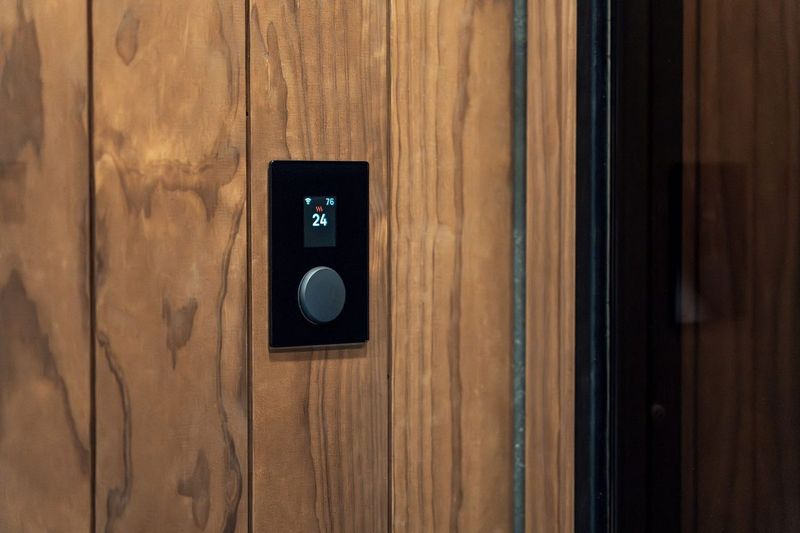
At 7.40am on Sunday 1 March I stood in the kitchen with a mug in one hand and the in-home display in the other, writing down the last day of February. The winter was over, on paper at least, and I could finally add it all up. It came to 6,850 kWh of gas.
The paperwork from the sale had a figure that I'd been wanting to put next to it. Tucked into the handover pack was Dennis's estimated annual gas use: 14,200 kWh. I've looked at that number on and off for a year, wondering whether we'd end up anywhere near it.
The numbers
- First full year, February 2025 to January 2026: 10,420 kWh of gas and 2,310 kWh of electricity.
- This winter, October to February: 6,850 kWh of gas, which is about 45 kWh a day over 151 days.
- Busiest day: 71 kWh on Saturday 17 January, the day after the snow, with the heating on from morning till night.
- Quietest day: 6 kWh on Wednesday 3 December. That's the day after the boiler stopped heating the house, so it says more about our diverter valve than about our habits.
Our first year came in 3,780 kWh below Dennis's estimate, or about 27% less. At roughly 6p to 7p a kWh for gas, that's somewhere between £230 and £265 a year of gas, before the standing charge. The first two months of that year come from the bills, because the smart meter wasn't fitted until 8 April. Everything after that is off the meter.
What I think made the difference
First, we're out. Matt and I are both at work three days a week, and the heating is off between about 8am and 5pm. Second, we run the house cooler: 19°C for the early morning blast and about 18.5°C in the front room in the evenings. Third, the boiler flow temperature went down to 55°C in September. The radiators are only warm, not hot, but the house still gets there, just more slowly.
I'd put the draught-proofing next. The £48 of brush strips and sealant in September made the front door stop whistling, and there is no longer a breeze across the hall floor. The gutter repair may have helped the gable wall dry out, and a drier wall loses less heat. I can't prove that. From 21 January I also heated only the box room on work-from-home days, but that saved something like 70 kWh across six days, which is a rounding error against a winter.
Why you shouldn't trust my comparison
The 14,200 is an estimate, not a reading. Nobody can tell me how much gas Dennis really used. The house stood empty from the spring of 2024, and I suspect the figure is a model of an older man at home all day with the heating on, not a measurement of anything. I would not hold up our 27% in front of an energy adviser.
The weather is another reason. This winter had a night at -3°C on 2 December and snow on the hill in January, but I don't know how it stacks up against a normal Sheffield winter, and a colder or milder one could easily have moved our total by a tenth either way, which is more than most of what I did with the thermostat. And we share a wall with Maureen, who keeps her heating at a temperature that would suit a tomato. I can't measure what that does for us, but I suspect we have been subsidised through the brickwork.
The one thing the numbers didn't change is the back bedroom. We used less gas than the paperwork suggested and the room is still the coldest in the house, which is a good reminder that the gas meter measures the fuel and has no opinion about where the heat goes. That is a job for May half-term.
Our fixed tariff runs out on Monday, so the question for this week is the price per kWh, not the number of them.