The man from the second firm put his palm flat on the back bedroom gable wall at 11.20am on Friday 6 February and said, "Yep. That's cold." It took him about four seconds. I had spent three months with a £14 infrared thermometer working out the same thing, and I'd written it in a spreadsheet.
The numbers are these. On the coldest mornings the corner of that wall reads 12°C, while the other walls in the room sit at about 16°C. It is the outer wall of the room, facing the gennel, and the coldest surface in the house. The gutter is mended, the mould has been wiped, and in October a camera showed us that the cavity fill is slumped and patchy, which is why we haven't paid £2,600 to have it pulled out and replaced. The next idea is to insulate that wall from the inside.
Three quotes
The visits were on Wednesday 4 February, Friday 6 February and Wednesday 11 February, each one forty minutes and a brew. All three would fix insulated plasterboard to the gable wall. What differed was what came with it.
- £1,450: board fixed to the wall, joints taped and the whole wall skimmed, ready to paint. The socket, the radiator and the skirting were extra, and nobody asked about the wall behind.
- £1,980: the same, plus a plumber to take the radiator off and put it back, an electrician to move the socket and new skirting. This was the man with the palm.
- £2,300: a damp meter reading before anything else, a vapour control layer, every joint taped, and a ten-year guarantee. This was the only man who asked about the gutter and the cavity, and who wrote down "ventilation" on his pad.
I liked all three of them. I just couldn't work out from the numbers what I was paying for in the third, other than someone who asked more questions.
What 6 cm costs
The board is about 6 cm thick all told, which is what we'd lose from the room. The room is roughly 3 m wide, so that's 2%, which sounds like nothing until I think about where the bed goes. The window on that side gets a deeper reveal. The radiator has to come off and go back on longer pipes, and the socket has to move out by 6 cm or be buried. It isn't something you can undo afterwards, so I wanted to think about it properly.
I also did the sums on the gas. One wall of a 77 m² house is not going to change the bill much, and my guess is £30 to £50 a year. That is not why we're doing it. We're doing it for the corner and for the room, so that the back bedroom might finally be somewhere a guest could sleep in January.
The second thought
Insulating from the inside makes the wall behind the boards colder than it was. If warm, damp air from the room gets through the joints and meets that cold wall, water can collect where no one can see it. That is why the taped joints and the vapour layer matter, and why the wall has to be dry before anything goes on it. Since September's gutter repair the hygrometer readings in that room have come down, but I want a few more months of them through the spring. I asked all three how they'd deal with moisture in our wall. Two gave me a sentence and the third gave me a page. Your own wall will need its own surveyor's view.
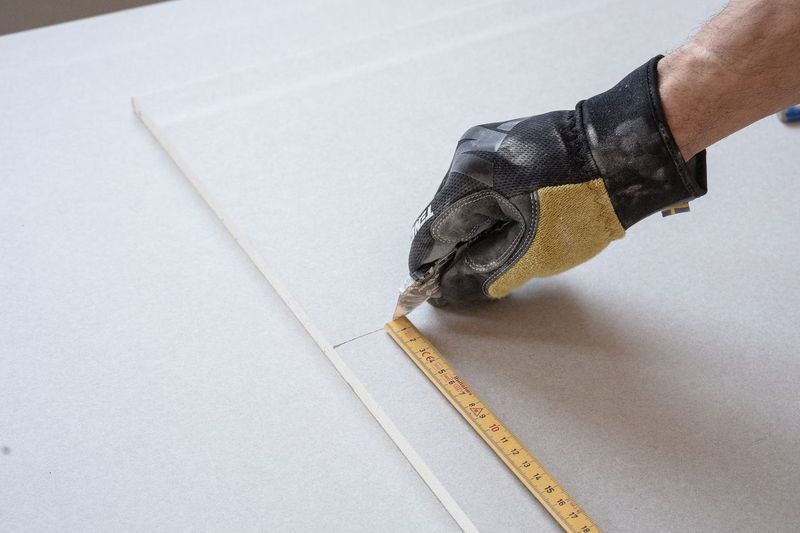
So the decision is to wait, and to do most of it ourselves. Matt will fix the boards in May half-term, the week of 25 May, because cutting and fixing insulated board is carpentry and he has done plenty of that. The plasterer who overboarded the Artex ceiling last April has said that skimming one wall would be about £250 to £300. The electrician who fitted the extractor fan thought £100 to £150 for the socket. Taking the radiator off and putting it back is on the list too, and whether Matt does that or the engineer who services the boiler does is a May question. My sums come to around £800 all in, with materials at about £400. Against the quotes, that leaves between £650 and £1,500 for the kitchen we keep talking about.
Last Sunday Matt put a strip of masking tape on the carpet 6 cm from the wall. The bed fits either side of it. I keep stepping over the line on my way to the wardrobe, and so far I haven't minded.